Interview: Ged Duffy — Factory, Stockholm Monsters and Manchester
Alejandro De LunaGed Duffy Interview: August 2026 by Alejandro De Luna
I spoke to Ged Duffy on 28 August, the founding bassist of Stockholm Monsters and part of Factory Records’ early circle. It was a genuinely interesting call that ran well past the hour we had agreed on. A few days later, he was flying to Boston and New York to see his mate Peter Hook play. Hook had looked after Stockholm Monsters during their early Factory days and remains one of Ged’s bass heroes.
Ged is quite a character, in the best sense: friendly, very chatty, full of Mancunian humour, and with an Irish family background that comes through in what a natural storyteller he is. He has stories about Manchester, Factory Records, Martin Hannett, the Haçienda and the bands he saw in their early days: The Damned, the best live band he saw at the time; The Cure as a support act; and The Smiths sharing a bill with Richard Hell.
He belongs to a generation of Manchester characters who experienced firsthand the years that people around the world now romanticise.

Factory Fairy Tales by Ged Duffy, founding bassist of Stockholm Monsters
It is no surprise that Factory Fairy Tales, Ged’s autobiography named after Stockholm Monsters’ first single, has sold more than 3,000 copies despite his being a first-time author. People want to hear stories like his.
“I never thought I’d sell more than a couple of hundred, right? I kept waiting for the reviews to come in and say, you know, this is awful. It made them laugh. It made them laugh again. It made them cry. And then it made them laugh again.”
Here is some of what went on during that call with Ged.
How Ged Duffy met Rob Gretton
The first time Ged Duffy met Rob Gretton, they were fighting outside Old Trafford.
Manchester United were playing Manchester City on an unusual Wednesday night, and trouble broke out on Railway Road. When the police dispersed the crowd, Ged turned to his friend Slim and said that the City supporter he had been fighting looked familiar.
The following night, Ged went to Rafters to see Generation X. He approached the DJ booth and found himself looking at the same man. They recognised each other immediately.
“We both said exactly the same thing at the same time: ‘Oh, it’s you.’”
After a moment, the stranger pushed his glasses back up his nose, held out his hand and said: “My name’s Rob.”
“And I said, ‘I’m Ged.’ That’s how I met Rob Gretton.”
It is difficult to imagine a more Mancunian introduction: the kind of scene that could easily have appeared in Michael Winterbottom’s 24 Hour Party People.

Rob Gretton, manager of Joy Division and New Order. Photo: Kevin Cummins.
Gretton would become the manager of Joy Division and New Order and one of the central figures in Factory Records. Duffy would help form Stockholm Monsters, play bass on their first two Factory singles and later establish the two-bass group Lavolta Lakota.
Their friendship would include further arguments, another couple of fights and, eventually, decades of stories.
Those stories form the substance of Ged’s memoirs, Factory Fairy Tales and its forthcoming continuation, Happy Ever After. They also offer a view of Manchester music from somewhere particularly valuable: close to the centre of events, but outside the small circle of familiar names through whom its history is usually told.
“I’ve kissed the Blarney Stone three or four times,” Ged told me when I suggested that he should have his own podcast. “If you kiss the Blarney Stone, you’re blessed with the art of being a storyteller.”
Then he offered a more local explanation.
“I’ve got the Irish DNA, which is being a storyteller. And then I’ve got the Manchester DNA: you’ve got attitude.”
Learning from the Russell Club floor
Before he became a musician, Ged worked as a stagehand at the Russell Club in Hulme. He and Slim encountered bands during the afternoon, helped assemble the stage, watched them perform and often spoke to them again afterwards. It provided an education unavailable in any rehearsal room.
“We worked them all. You got to meet the bands in the afternoon, so you got to talk to them. Then we’d set the stage up and talk to them afterwards. It was great.”
He remembers The Damned particularly fondly. During the band’s brief 1978 incarnation as the Doomed, Ged saw them at the Russell Club with Lemmy playing bass.
“He played proper bass, not the wild, crazy bass he played in Motörhead. That was the first time we saw The Damned. Then we saw them four times the next year at the Russell Club. We got to know them pretty well. We got to know the Buzzcocks and Slaughter & the Dogs.”

Lemmy playing bass with The Damned during their 1978 'Doomed' period. Photographer unknown.
Ged also knew Ian Curtis from the Manchester record shop where Curtis worked. He saw The Cure before their eventual stature seemed remotely inevitable.
“People don’t believe you when you say, ‘I saw The Cure supporting someone at the Russell Club, and there were maybe only 150 people there.’ But it didn’t mean anything to us. It was just: who’s playing tonight? Then you were amazed at how big some of the bands became.”
The proximity stripped away the mythology. These were not yet names fixed in musical history. They were young groups arriving in a neglected part of Manchester, carrying their equipment into a room where Duffy happened to work.
His own punk conversion did not happen at a concert. Like many people his age, he saw the Sex Pistols on Tony Wilson’s So It Goes rather than at the Lesser Free Trade Hall.
Four strings will be easy
Stockholm Monsters began after Tony France moved into Burnage. Ged immediately thought that France looked like a singer. Through the Cyprus Tavern and their shared enthusiasm for Model Team International, the group that would become James, the beginnings of a band emerged.
Duffy originally intended to sing and then considered playing guitar. Neither plan survived contact with his own abilities.
“I couldn’t sing, so Tony became the singer. I played guitar, but I couldn’t play guitar. In the end, I bought a bass. Four strings: that’ll be easy. Six to four, you know?”
The crucial addition was Lita Hira, the classically trained pianist and twin sister of drummer Shan Hira. Stockholm Monsters rehearsed in the attic of the Hira family home. One day, Lita entered and began playing the Farfisa organ that stood there.
“Tony and me, our favourite band was The Doors. We both looked at her and went: ‘The Doors.’ That was it. Lita was in. That’s when we started doing it properly, because she could play.”
The Rafters story is wrong
The familiar account of what happened next, Ged insists, is wrong.
Online histories have repeated a story in which Peter Hook discovered Stockholm Monsters at Rafters and subsequently brought them into Factory’s orbit.
“There’s a very famous story that Peter Hook discovered us playing at Rafters. That’s all wrong. It’s all over the internet, probably in books as well. I’ve told the guy who did the Stockholm Monsters website it’s all wrong too.”
According to Ged, Tony Wilson happened to be driving past the Cyprus Tavern when he noticed a queue outside. He stopped, went inside and discovered Duffy’s group performing.
“So this is your band at last,” Wilson told him.
After watching them, Wilson suggested leaving a cassette at the Factory office in Didsbury for Rob Gretton.
The demo led to shows with New Order, including a short run during which Stockholm Monsters travelled in the back of their van. That was how Ged got to know Peter Hook. Duffy and France asked whether he would manage the group, and Hook agreed.
“There was nothing to do with Rafters. They got it wrong.”
Martin Hannett and the two lives of ‘Fairy Tales’
That correction is more than a small piece of Factory discography. It changes the beginning of Stockholm Monsters’ story and leads directly to one of Ged’s most revealing memories: recording their first single, ‘Fairy Tales’.
The band’s demo version was driven equally by guitar and keyboards. By the time they entered Strawberry Studios, however, their guitarist had left. They planned to record the song without guitar and preserve its organ-led character.
Martin Hannett had other ideas.
Ged remembers arriving at the studio and waiting approximately three hours for the producer. When Hannett eventually appeared, he did not greet the group. Instead, he spent another hour arranging tablets, lines and a spliff across the U-shaped mixing desk.
He ordered Shan Hira to strip down his drum kit and play to a click track. When the band asked whether he wanted to hear the song first, Hannett declined. He rejected the Farfisa almost immediately and instructed Lita to use the studio’s grand piano.
“We argued with him. The whole song was the organ. It had a fairytale feel to it. He wouldn’t listen. He did his own tempo, everything.”
Duffy understands why listeners admire the Factory recording, but it was not the record Stockholm Monsters had imagined.
“I’ve listened to it over the years, and I understand why people like it. But it’s not the song we wanted it to be. It’s a completely different feeling.”
Two days at Strawberry Studios were supposed to produce two completed and mixed tracks. Instead, the group left with the A-side not yet mixed and no B-side recorded. Gretton was furious. Hannett would be allowed to mix ‘Fairy Tales’, but Peter Hook was brought in to produce the B-side at Cargo Studios.
The resulting ‘Death Is Slowly Coming’ was essentially invented in the studio. The band had intended to record another composition but struggled with its stops and starts. Ged had a bass line, began playing it and the musicians built a new song around it.
“We made the song up on the spot.”
Duffy also remembers Rolling Stone describing it as “the best psychedelic record ever made that hasn’t got a guitar in it”, although he no longer has the original review.
The contrast is wonderfully Factory: on one side, Hannett dismantling an existing song according to his own logic; on the other, Hook capturing a piece that barely existed before the tape began moving.
The sleeve provided another characteristically uneconomical chapter. Designer Mark Farrow presented Wilson with purple and green versions. Unable or unwilling to choose, Wilson reportedly replied: “Do them both, darling.”
Five thousand copies of each version were pressed, and Ged recalls that the elaborate sleeve cost more to manufacture than Factory received from its distributor for the record.
“They lost a fortune on that single.”

Stockholm Monsters, 'Fairy Tales' single sleeve, FAC 41.

Stockholm Monsters, 'Fairy Tales' single sleeve, alternate colour variant, FAC 41.
A Factory band that did not sound like one
For Ged, Stockholm Monsters’ problem was not a shortage of ideas but the assumptions attached to their label. Factory’s emerging reputation caused them to be grouped with what critics characterised as its sombre, austere bands.
“We got roped in with them all as a dour Factory band. And we weren’t.”
He points to ‘Fairy Tales’, ‘Death Is Slowly Coming’, ‘Happy Ever After’ and ‘Soft Babies’ and asks what single category could possibly contain them.
“What type of band were we? You can’t tell. All you can say is that we had a really good keyboard player. You couldn’t put us in a box, but we were put in a box. I think that’s why we never made it.”

Stockholm Monsters, 'Happy Ever After' single sleeve.
Only a few years later, that box would open again. Happy Mondays, The Stone Roses, Inspiral Carpets and others made irreverence, keyboards and working-class Manchester identity newly legible to the press. Duffy believes Stockholm Monsters anticipated something in that later moment without receiving its benefits.
I mentioned a remark attributed to Tony Wilson, describing Stockholm Monsters as Manchester’s first scally band, years before Happy Mondays. Ged immediately agreed with the description.
“Totally. We were nothing like a Factory band. There was nothing serious about us lot.”
He remembers Noel Gallagher describing Stockholm Monsters on television as the first band to emerge from Burnage and Oasis as the second. Ged also recalls Gallagher including ‘Fairy Tales’ in a published selection of favourite records.
The music may have resisted categorisation, but the group’s internal divisions became harder to overcome. After a European tour with New Order, Duffy felt increasingly isolated and left the band he had helped create.
Two basses and an unrealised future
By then, the Haçienda had opened, and Ged had worked on its stage crew from the first night. He had largely forgotten about being in a group until a chance encounter in a record shop opposite Band on the Wall led him towards forming another one.
Lavolta Lakota developed around an unusual instrumental idea: two bass guitars. Duffy used roundwound strings, turned up the treble and played with a plectrum, while the other bass was played with the fingers. The contrast gave the group its distinctive sound.
The group went on to support The Smiths at the Haçienda, play repeatedly with The Fall and appear with Death Cult and Cabaret Voltaire. Despite the increasingly impressive company, Ged became frustrated that the repertoire remained stuck at eight songs.
He devised a plan to transform the band. Some material would retain the two basses; other songs would introduce a second guitar or synthesizer. They would take January away from performing, concentrate on writing and return with a substantially expanded set.
It never happened.
During a show with Death Cult at Birmingham’s Tin Can Club, a man dressed as a Native American repeatedly climbed onto the stage and began dancing. Neither Duffy nor Slim knew that he was a friend of singer Dave Hicks, who had apparently intended his appearance as a good-luck dance. They removed him from the stage twice. Hicks abandoned the performance, an argument followed backstage, and Lavolta Lakota effectively ended that night.
Ged later came to believe that the mysterious dancer was Native American actor and musician Floyd Red Crow Westerman, whom he subsequently recognised as the shaman in Oliver Stone’s The Doors.
“He was doing a good-luck dance for us. All I could think when I found out was: ‘Well, that didn’t fucking work, did it?’”
Giving it up, then writing it all down
Ged continued playing in Manchester for several more years. The first incarnation of his next band was called The Shop; the second became Blue Moves. Wilson and Gretton liked the demos and repeatedly promised to sign the group once they could assemble a stable line-up and play a proper show.
Drummers and guitarists came and went. After performing a handful of concerts with backing tapes, Duffy finally decided that he had had enough. He sold his equipment and walked away from music around 1987.
The stories remained.
In 2017, Ged joined Facebook and found groups devoted to Joy Division, New Order, The Smiths and other bands he had encountered. He began sharing recollections, and readers repeatedly encouraged him to write a book. Lockdown finally gave him the opportunity.
He did not expect Factory Fairy Tales to find a publisher, much less a sizeable readership. It received around 280 pre-orders and has since sold more than 3,000 copies. The responses surprised him because readers consistently described the same emotional journey.
Manchester swagger, favourite bands and the bass players he can’t get past
A good chunk of the conversation drifted away from the band entirely, and I let it, because it was good talking. I told Ged about my own years living in Manchester and how the city and its people inspired me to begin The Sense of Doubt, first through my prints and then through the stories surrounding the music.
Ged has a theory, only half-serious, that growing up in Manchester comes down to three things: music, football and fashion, in an order he can never quite settle on.
We also talked about Manchester’s large Irish community and the storytelling instinct and attitude running through so many of the city’s bands with Irish family roots, from The Smiths to Oasis.
Asked to name three bands he could never tire of, he chose The Doors, James and Joy Division.
James came with a particularly long history.
“James are my favourite band of all time. I just love James. I saw them twenty-five, thirty times before they became James. I go back a long way with those boys.”
Asked for three bass players, Ged found it impossible to stop at three. His five were Peter Hook, Siouxsie and the Banshees’ Steven Severin, Jean-Jacques Burnel of The Stranglers, John Entwistle of The Who and Lemmy.
Entwistle, in his telling, was one of the first musicians to make the bass behave like a lead guitar rather than simply holding down the bottom end.
Lemmy represented something else entirely.
Ged remembered watching footage in which Lemmy demonstrated the difference between an ordinary bass sound and his own. He first played his Rickenbacker cleanly, then turned around and activated every switch and dial on his Marshall amplifier.
“He said, ‘This is what Lemmy sounds like.’ It was like a bomb going off.”
For Ged, Lemmy did not so much play tunes on the bass as play chords, hitting all four strings simultaneously and producing something distorted, enormous and unmistakably his own.
“It was just crazy. But he was a brilliant bass player.”
Perhaps that explains why Ged still speaks so warmly about Peter Hook, the friend he was about to fly across the Atlantic to see. These were bassists who refused to remain in the background.
Happy Ever After
More than four decades later, Ged is still telling these stories, and there are plenty more to come. His forthcoming second book, Happy Ever After, continues where Factory Fairy Tales left off.
The title completes a circle that began more than four decades ago. ‘Fairy Tales’ was Stockholm Monsters’ first Factory single; ‘Happy Ever After’ was their second. Ged explained that the second song’s title originated as a nickname for a woman connected to the band. It was not deliberately conceived as a continuation of ‘Fairy Tales’; the sequence simply happened that way.
The two book titles now tell their own story: Factory Fairy Tales, followed by Happy Ever After.
Music, football and fashion run through Ged’s memories, often in the same story. They preserve the humour and swagger of people who had no idea that the ordinary rooms around them would one day become part of musical history.
Many thanks to Ged Duffy for his time, generosity and stories. I look forward to reading the next chapter.
Buy Ged's Factory Fairy Tales here.
Alejandro De Luna single-handedly runs The Sense of Doubt, an independent music and culture site exploring music history, post-punk, art and cultural heritage through limited prints and features. This interview is part of an ongoing series.
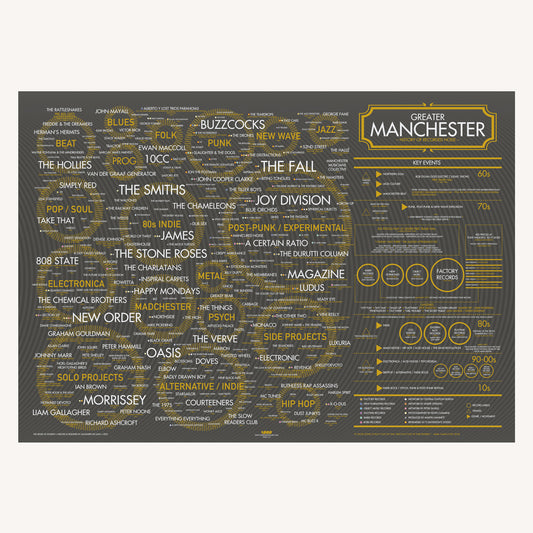
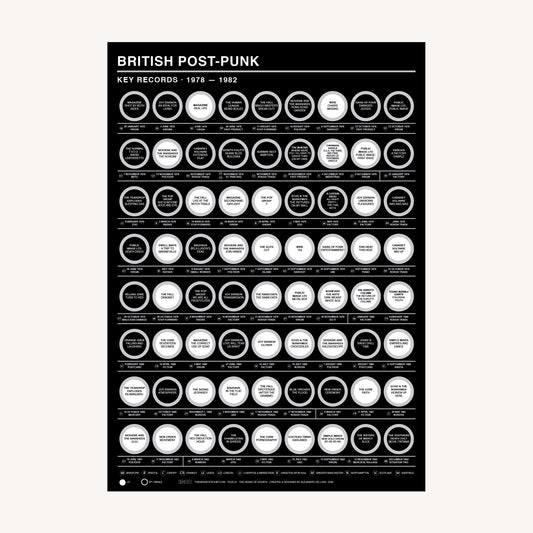
If you are interested in Manchester music history and Factory Records you may like these prints.