Interview: Simon Wolstencroft — Nearly a Stone Rose, Nearly a Smith, Eleven Years in The Fall
Alejandro De LunaWhen you think about Manchester musicians who can tell a good story, who have the credentials for it and know what they're talking about because they were there since the thing exploded, there's Simon Wolstencroft.
There's a version of Manchester's music history where he's the drummer for The Stone Roses. Another where he's the drummer for The Smiths. In the one that actually happened, he spent eleven years behind Mark E. Smith in The Fall, propping up some of the most brilliant records to come out of the city, and turned down the other two on his own terms, once because a session felt wrong, once because the timing did.
Si modelling for Liam Gallagher's Pretty Green, Autumn 2022
He started out in Freak Party with a teenage Johnny Marr and Andy Rourke, chasing the low-slung funk of A Certain Ratio in Rourke's living room while Marr's dad was out on business. He drummed with The Patrol, an early incarnation of the Roses before they were the Roses. He said no to Morrissey, but not before playing on the first Smiths demos of 'The Hands That Rock the Cradle' and 'Suffer Little Children,' recorded at Decibelle Studio, Manchester, 1982, with Dale Hibbert on bass. He said yes, eventually, to Mark E. Smith, and spent eleven years drumming on Bend Sinister, The Infotainment Scan, Middle Class Revolt and into the chaotic sessions for Levitate in 1997, when a dispute over the recording finally ended his run in the band. This Nation's Saving Grace came out the year before he joined, and it's still the Fall record he loves most. Later he ended up behind Ian Brown, in a completely different world of major-label discipline.
He's written a memoir about all of it, You Can Drum But You Can't Hide, and these days he's still behind a kit, drumming in House of All, the band of ex-Fall members (Martin Bramah, Steve and Paul Hanley, Pete Greenway, and more recently Karl Burns) who found each other again in 2023 and have kept making records together since. He also co-hosts a podcast, Funky Si's A-Z of Manchester, with Jackie O'Malley, working through the city's music history letter by letter, and walks people round Manchester telling the stories he can still remember. Below, in his own words, is what he told me about Donald Johnson's hi-hats, Ian Brown, Morrissey, Mark E. Smith's rules, Manchester music DNA and the one regret he'll actually admit to.
Q&A Interview: August 2026 by Alejandro De Luna
My sincere thanks to Simon Wolstencroft for doing this interview. And for the great music.

Photo: Claire Bailey
1. You've mentioned Freak Party moved your drumming away from punk towards funk and jazz-funk, with Donald Johnson of A Certain Ratio a major influence. What did you hear in his playing that changed yours?
Don's a superb drummer. So precise and effortless.
Funky as hell.
Following punk then Two Tone I started listening to Grandmaster Flash, Chic and Funkadelic round at Smiths bass player Andy Rourke's dad's house.
His old man was always away on business so Johnny Marr would always bring his guitar over and play along with Andy to funk tunes stoned, on a massive pair of speakers in the lounge there.
No drum kit.
ACR's Sextet was one of those albums we played over and over. I loved Don's sixteenths hi hat patterns and his kick drum patterns starting 'on the one' (the first beat at the start of the bar) and his ghost notes. It made a big impression on me.
I think we wanted our new band Freak Party to sound like A Certain Ratio.
We just couldn't find a singer!
2. At different points you played with Morrissey, Ian Brown and Mark E. Smith. From behind the kit, how different was it working with three such strong personalities?
All 3 were different in their own way.
You have to remember I turned down the Smiths after one recording session for several reasons. Possibly the most important being the absence of Andy Rourke who wasn't invited to the session in Ancoats. The first song we put down was 'Suffer Little Children' was very slow and dark with dubious lyrics. I'd been listening to ABC's 'The Lexicon of Love', we all had and this was a million miles away. Morrissey wouldn't look me in the eye and despite Johnny begging me to join 'his new band' I declined.

Simon with Johnny Marr. Image via Wakefield Express.
Mark E. Smith was a different thing altogether.
Drumming with the Fall was fun at first, for the first five years anyway. You never knew what sort of state he'd be in from day to day so you had to watch your step. Most songs were uptempo and recorded in two takes without much time to develop the arrangements, often very repetitive.
No fancy drumrolls, "Stop showing off" he'd scream, but I found him very funny at times and considered him a mate.

The Fall. Photo: Paul Cox
When I joined Ian Brown's solo band in 1999 for the Golden Greats album/tour I found his way of working different again. Polydor Records left nothing to chance, nothing. Ian wanted it to be the best it could be too. No boozing and tantrums with my old school classmate. Business, business, business.

Simon with Ian Brown. Image via Wakefield Express.
3. You joined The Fall just as the Bend Sinister period began. Do you hear your arrival as part of a change in the band's rhythmic sound?
Yes. I'd replaced Karl Burns and had a lot to live up to, he's a brilliant drummer and I was aware it'd take a lot to fill his boots.
I just kept it simple like Mark told me to. No fancy rolls. Bass player Steve Hanley was the guiding force in the band. Steve definitely has a unique style.
My favourite track off Bend Sinister easy.
Realm of Dusk. It was the first song we recorded at Abbey Road.

Photo from my Fall collection.
4. You've said This Nation's Saving Grace is your favourite Fall album, despite joining just afterwards. What is it about that record that still gets you?
I'd not paid any attention to the Fall until I heard this album. I was hanging out in Hulme which was a hotbed of musicians and artists in the early eighties. Karl brought the album round and I loved John Leckie's production. It was really powerful stuff, with a pop sensibility due to Brix's vocals.
Gut the Quantifier, Bombast, Cruisers Creek.
I could go on.
5. Some of my favourite Fall records are The Infotainment Scan and Middle Class Revolt. What memories stand out from that period around 1993–94?
I loved touring America with the Infotainment Scan, a great album in my opinion. Karl had rejoined on percussion at first which worked really well with my minimalist drum patterns.
However a year or so later I'd returned from a week's holiday only to find the band had started recording without me in North Wales.
I raced to the Windings Studios which was in the middle of nowhere only to catch Karl red handed putting beats down for The Middle Class Revolt.
I was pissed off and my relationship with Mark changed after that. I don't like the album either!
6. Three bands or artists you could never get tired of, and three drummers who influenced you most. Who makes the list?
I never tire of listening to Earth, Wind and Fire, Michael Jackson and Grace Jones.
John 'JR' Robinson played on 'Off the Wall'.
Incredible feel, he's definitely up there for me.
Sly Dunbar and Topper Headon from the Clash.
7. You now literally walk people through Manchester's music history. Has showing other people around the city changed the way you remember your own years there, or made you see any part of that history differently?
There's loads of things I can't remember from my youth. I love it when people remind me of mad stories that I have no recollection of whatsoever.
Sometimes my antics were quite shocking to be honest. Just say no, kids!
I'm just really proud to have been part of the music scene for such a long time and like to pass on the stories I do remember to interested parties.
8. If you had to explain Manchester's musical DNA without mentioning a single band or genre, what would you say?
There must be something in the water that makes Manchester produce top bands again and again.
It's a big city of course but not too big so it's easier to network with like minded musicians.
This was the case even before the internet was invented.
The football teams here helped too.
We shouldn't forget Liverpool either.
Although Manchester has produced the coolest bands.
9. Is there a story you've always wanted to tell in an interview, but nobody has ever asked the right question?
I've turned down the Smiths and drummed with an early incarnation of the Roses.
No one's ever asked which of the 2 bands I would've liked to be a member of.
It would be the Smiths if I had my time again!
Book Simon's Manchester music history tours here.
Buy Simon's autobiography here.
Listen to Simon's Funky Si's A-Z of Manchester podcast here.
Follow Simon on Instagram and Facebook.
Alejandro De Luna single-handedly runs The Sense of Doubt, an independent music and culture site exploring music history, post-punk, art and cultural heritage through limited prints and features. This interview is part of an ongoing series.
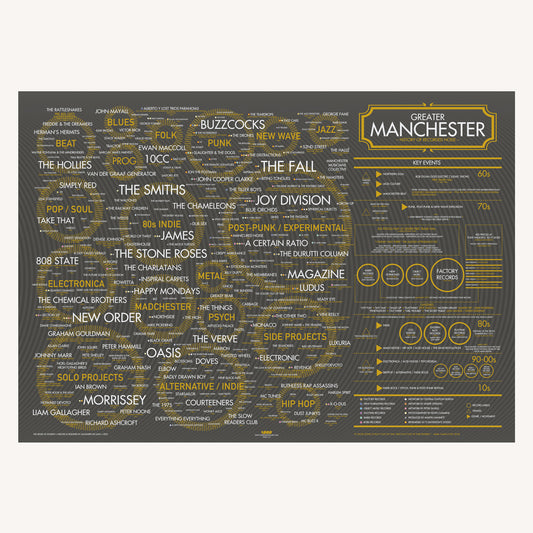
If you are interested in The Fall, you may like this print.