Women Who Shaped the Look of British Post-Punk: Linder Sterling
Alejandro De LunaIn 1977, Buzzcocks released "Orgasm Addict," and the cover showed a nude female torso with a clothes iron for a head and mouths where the nipples should be. It was cut by hand from a glamour magazine and an Argos catalogue. No one had seen a major-label single wear that on its sleeve before.

The person who made it was Linder Sterling, and for most of the post-punk era, she wasn't just designing record covers on the side. She was near the center of the whole scene, romantically and creatively tangled up with the people making the music, before going on to a solo career of her own. Whether as a photographer, visual artist, or musician, her work spans nearly fifty years.
Manchester Polytechnic, and the birth of "Linder"
She was born Linda Mulvey in Liverpool in 1954 and studied graphic design at Manchester Polytechnic (now Manchester Metropolitan University) from 1974 to 1977. Manchester in those years was small enough that the entire punk and post-punk scene fit into a handful of venues and shared flats. She adopted the single name Linder as a kind of working persona, distinct from the design student underneath it, and started making photomontage work that spliced the polish of fashion and appliance advertising with the anatomy usually left out of both.
She met Buzzcocks early, introducing the band on stage at Manchester's Lesser Free Trade Hall in the summer of 1976, and turning up again at the soundcheck for the Sex Pistols' third Manchester gig not long after. She was dating Howard Devoto, Buzzcocks' original singer, and when he left the band to chase something more art-damaged with Magazine, she went too, designing the cover for Magazine's 1978 debut album, Real Life. He later produced a demo for her own band, Ludus, in February 1979.

Whalley Range, and a friendship that outlasted everything else
For a stretch of the late seventies, Linder shared a flat in Whalley Range, a Manchester neighbourhood a few miles south of the city centre, with Magazine guitarist John McGeoch. A teenage Morrissey, who'd met her at that same Sex Pistols soundcheck, became a regular presence there, close enough that The Smiths later sang about it directly: "Miserable Lie" references "a rented room in Whalley Range."
The friendship became one of the longest-running relationships either of them has had in music. Years later, walks the two of them took together through Manchester's Southern Cemetery gave Morrissey the material for "Cemetery Gates," released on The Queen Is Dead in 1986. Buzzcocks' "What Do I Get?" is also widely understood to be about her. When a 2017 biopic of young Morrissey, England Is Mine, cast an actress to play her, Linder called it a form of identity theft and has said she's never watched it.
The meat dress, and what it was actually about
Linder fronted Ludus from 1978 until the band split in 1983, and designed most of their artwork alongside singing. The band's most talked-about night came on 5 November 1982, at Manchester's Haçienda, then a nearly empty room mostly known for showing pornography on its screens between sets. Linder had her seamstress sew raw meat, some accounts say chicken parts from a local takeaway, onto a bodice in the hour before she went on stage, in direct protest at the venue's habit of running porn reels over the dancefloor. She and two friends handed out paper plates with tampons and cigarette stubs to the audience. At the climax of the set, she removed her skirt to reveal not herself but a black dildo underneath.
It's now widely cited as the direct precursor to Lady Gaga's meat dress at the 2010 MTV Video Music Awards, nearly thirty years later. But guess who gets the credit?
After post-punk
Linder never stopped working once the scene around her moved on. Her photomontage practice carried into photography, performance, and eventually large installation and ballet work, including collaborations with choreographer Kenneth Tindall. Five of her pieces now sit in the Tate's permanent collection. In 2017 she won the Paul Hamlyn Foundation Award, one of the UK's largest art prizes, and the following year she was artist-in-residence at Chatsworth House while Nottingham Contemporary staged a retrospective of her work, The House of Fame. In 2025, the Hayward Gallery gave her a first full London retrospective, Danger Came Smiling, a title borrowed from a Ludus album she'd written decades earlier as a young singer in Manchester.
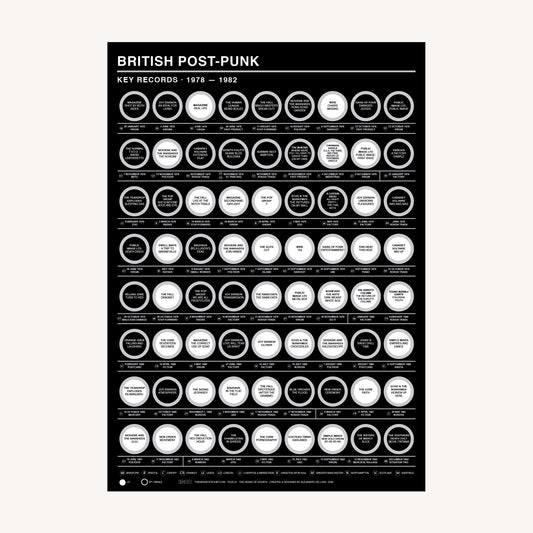
I picked up a retrospective Linder book in 2018 at her Nottingham Contemporary exhibition, and it's been proudly on my shelf since. It ended up back on my desk while I was unpacking a fresh batch of the British post-punk print and it kind of made sense to me. The print maps four foundational years of British post-punk: key records in my eye, chronologically organised, label by label, city by city, from Magazine's first single through the records that came after.
Linder is a large part of why the era had a face to go with it.


Alejandro De Luna single-handedly runs The Sense of Doubt, an independent music and culture site exploring music history, post-punk, art and cultural heritage through limited prints and features.